Inteldefense
Transforming in Contact Is a Procurement Story
The Army's field-testing push is usually described as a training change. Read the schedule and it is an admission about the requirement document.
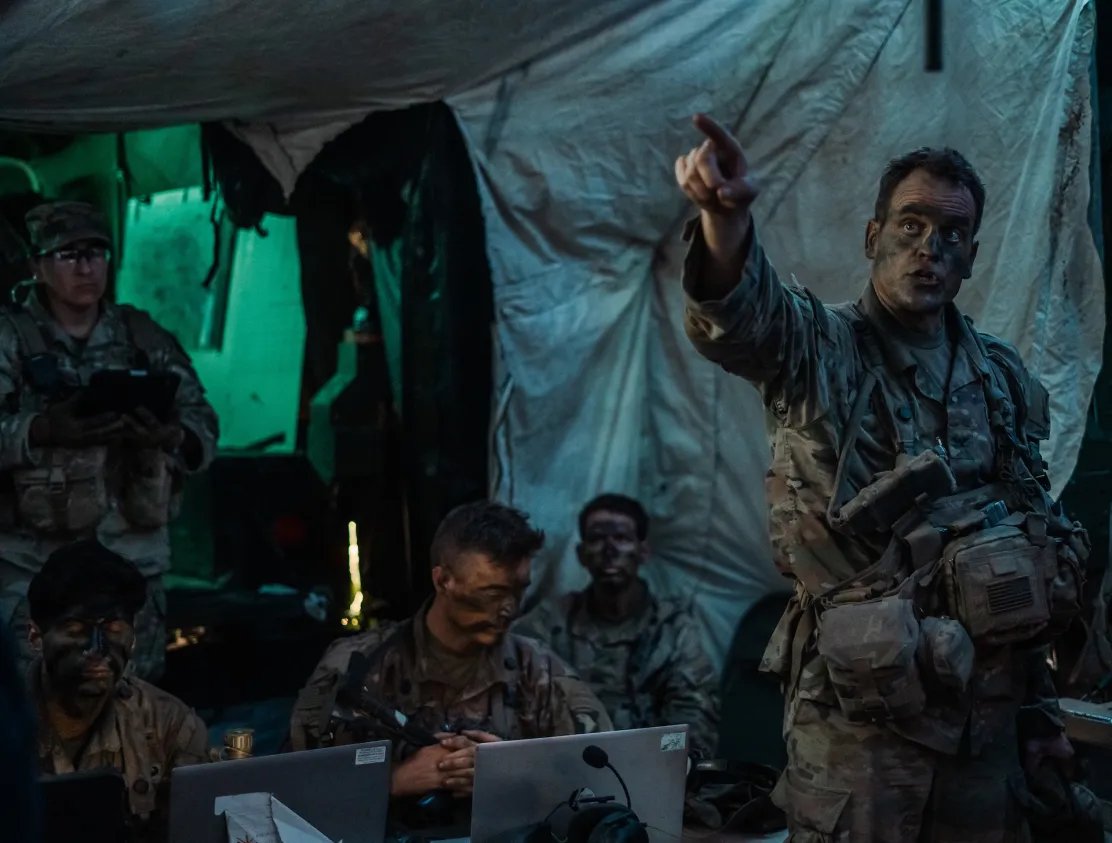
2nd Mobile Brigade Combat Team at the Joint Readiness Training Center, August 2024. Photograph: U.S. Army.
In August 2024 the Army sent its first Mobile Brigade Combat Team through the Joint Readiness Training Center at Fort Johnson. The 2nd Brigade of the 101st Airborne was there to test new gear in the field, including electronic warfare systems and drones, and to find out what broke.
The coverage framed it as a training story, and it was one. But the more interesting reading is that it was an admission.
For decades the sequence was: write a requirement, buy to it, field it, then discover in combat whether the requirement was right. The Army's phrase for the alternative is "transforming in contact." The unit uses the thing, the thing changes, and the change goes back into the requirement. That sequence only works if the requirement is allowed to move, which is not what the acquisition system is built to reward.
What the rotation actually demonstrated
The reporting from the period (opens in a new tab) describes a brigade evaluating commercial and off-the-shelf technology under realistic conditions, with the results feeding modernization decisions rather than a paper staff process.
The cheap-drone story is the one that travels. Modified commercial drones used as decoys, at a cost that makes losing them acceptable, pulling an opposing force into spending resources on nothing. That is a real operational idea and it is not a procurement breakthrough. It is what happens when a unit is allowed to buy a thing that costs less than the paperwork to procure it.
The harder test is the electronic warfare kit. Radios and jammers have to interoperate, they have to be sustained in the field, and they have to be configured by soldiers rather than by contractors. A rotation surfaces those problems in two weeks. A requirements review surfaces them in a document.
Why this is a procurement story
Three features of the approach do not fit the standard acquisition model.
The unit is the acceptance tester. A brigade that says "this works" is a different signal from a test range that says "this meets threshold." It is closer to how commercial software gets bought, and it moves the expensive discovery earlier.
The schedule is set by the rotation, not the milestone. When the calendar is a training event, the deliverable has to be in the soldiers' hands on that date. That is a forcing function a milestone review cannot reproduce, because a milestone can slip without anyone noticing until a funding line moves.
The variant matters more than the requirement. A thing that works after a soldier modifies it in the motor pool is the thing you should buy. Recording that modification, and buying the modified version, is a configuration management problem the traditional process handles badly.
So the reform is not "buy commercial." It is "shorten the loop between fielding and changing the requirement." Commercial technology is how the loop gets short, because the commercial market has already absorbed the development cost.
The two things that break
The first is sustainment. A brigade can field a hundred modified drones for a rotation. A force has to maintain them for a decade: spares, batteries, firmware, repair, and a supply system that recognizes the part number. Commercial gear churns fast, and the military's sustainment model assumes stability. When the vendor ships version four, the fielded fleet becomes three variants with three bills of material.
The second is training. A rotation produces a unit that knows how to use the gear. It does not produce a pipeline that teaches the next unit, unless somebody writes the program. Most of the failures in this pattern are not technology failures. They are the absence of a school, a manual, and a maintenance allocation chart.
There is a third, quieter one: the data. If the point of fielding fast is to learn, the learning has to be captured in a form someone can use later. A rotation that produces a slide deck and no structured record of what was tried, what failed, and what changed is a very expensive demo.
What makes it stick
The pattern that works is boring and it is the same one every product company learns.
Pick a variant, name it, and put it on contract. A modified commercial item that stays a modification is a science project. Once it has a part number, a technical manual, and a sustainment line, it is a capability.
Fund the spares before the fielding. A hundred units with no spares is a demonstration, not a fielding.
Write the training before the second rotation. The first unit will figure it out. The second one needs the school.
Keep the record. What was tested, at which rotation, against what threat, with what result. That record is how the next program avoids re-learning the same lesson, and it is the artifact an auditor will ask for when the program of record is proposed.
The part that is genuinely new
The Army has run field tests forever. What is different here is the willingness to let a unit's experience change a requirement inside a budget cycle instead of after one.
That is a cultural change, and culture is the part that does not survive a change of command unless it is written into how money moves. A service that rewards a program for holding its requirement stable will get stable requirements, whatever the doctrine says.
Fielding in contact only works if the budget can absorb what the contact teaches. Otherwise the lesson arrives, everyone agrees, and the change waits for the next cycle, which is where the last twenty years of good ideas went.
The commercial technology is the easy part. It is available, it is cheap relative to a development program, and it works. The hard part is a financial system that treats a discovered requirement as a legitimate reason to move money, and that is not something a vendor can sell you.