Inteldefense
The Hyper-Enabled Operator Is a Training Problem
At SOF Week 2025, SOCOM's own industry panel rated AI progress a six or seven out of ten and named digital fluency, not devices, as the gap.
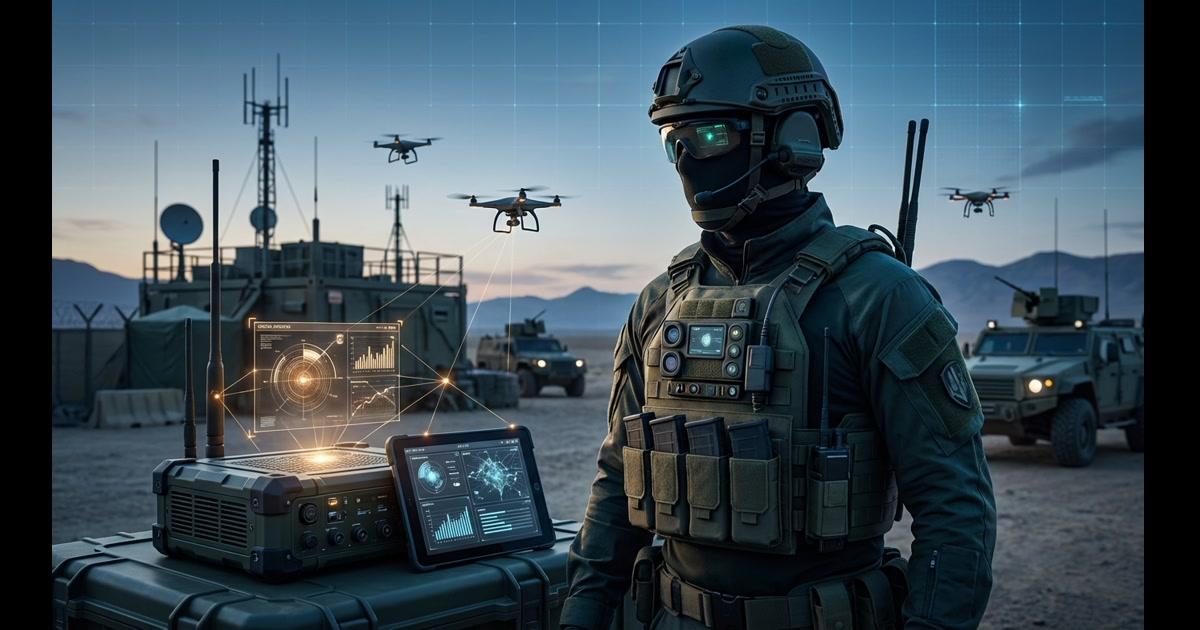
At SOF Week 2025 in Tampa, the most useful number came from a fireside chat, not a booth. Asked to rate U.S. Special Operations Command's progress on AI over the past year, one industry panelist said "six or seven" out of ten.
That is a good score from someone with an incentive to be polite, and it is also a diagnostic. The gap SOCOM's own partners named was not compute, bandwidth, or model quality. It was digital fluency: the ability of the force to understand what the tool is doing and apply it without being told.
A six out of ten, from the people selling it
The DoD account of the panel (opens in a new tab) is worth reading closely. Akash Jain, a private-sector AI leader whose company works with the department, credited senior leadership with pushing software acquisition and implementation forward. Thomas Tull agreed that command leadership had committed publicly and that change was moving in the right direction.
Then both of them named the same constraint. Tull described an ongoing need for digital fluency, meaning the force should not just use AI but understand how it works. Jain pointed at legacy hardware integration as a place where the command can still grow.
Those are not model problems. They are the problems you get when the technology arrives before the institution has a way to absorb it.
The device is the easy part
Edge AI demonstrations are persuasive because they are visible. A ruggedized device, a local model, a translation or recognition task that runs without a network. The audience can see it work.
The physical constraints are real and unglamorous. A battery pack that lasts through a mission. Heat that has to go somewhere in a sealed enclosure. Storage for model weights. A way to update the model in a forward location without a network path. A fallback when the device fails.
Every one of those is an engineering problem with a known solution space. None of them are the reason a capability stalls.
The reason a capability stalls is that nobody wrote down who is allowed to use the output, what happens when it is wrong, and how the operator learns to tell the difference. That is a training and policy problem, and it does not photograph.
Digital fluency is a procurement problem
SOCOM has already taken a step that most organizations talk about. Roughly 400 of the command's leaders completed a six-week course on digital fluency affiliated with MIT, according to the same DoD account.
That is the right instinct, and it is not enough on its own. A course teaches vocabulary. Fluency comes from repetition with consequences, which means the force needs tools in the workflow, feedback on when the tool is wrong, and a reason to care.
There is a procurement angle here that gets missed. If every AI capability arrives as a bespoke program with its own interface, its own training, and its own support contract, the force has to learn each one from scratch. If capabilities arrive as a small number of surfaces with shared conventions, fluency compounds.
The services know this pattern from other domains. The reason a soldier can pick up a radio from a different manufacturer is that the interface conventions are standardized. AI tools in tactical formations have no equivalent convention yet.
What an acceptance test should ask
A demonstration answers the question "can it work." An acceptance test answers "can this unit use it under pressure."
The difference is a set of questions that cost nothing to write down and are routinely skipped:
- Who is allowed to act on the output? A translation, a recognition result, or a recommendation has an authority attached to it, or it is trivia.
- What does the operator do when the tool is wrong? If the answer is "they would know," the tool has not been evaluated. Wrong outputs have to be recognizable at the point of use.
- How is proficiency measured after the course? A completion certificate is not a measurement. A timed task with a failure rate is.
- What happens when the network is gone? Degraded mode is a requirement, not an edge case. If the capability only works connected, it is a garrison capability.
- Who updates it, and how? A model that cannot be updated in theater will be stale by the second deployment.
The operator is still the system
The phrase "hyper-enabled operator" invites a picture of a person wearing a lot of equipment. The more useful reading is a person who can make a decision faster because the information arrived in a form they can trust and check.
That person is produced by training, repetition, and a clear chain of accountability. The equipment helps. It is not the thing being enabled.
SOCOM's own panel put the score at six or seven and pointed at fluency. That is a more honest assessment than most public statements about military AI, and it points at the work that actually takes time.