Intel
Writing
Field notes on AI, federal technology and building products. Start with the newest below if you are new here.
More: how I work.
New here? Start with four places.
46 articles in AI · page 1 of 2
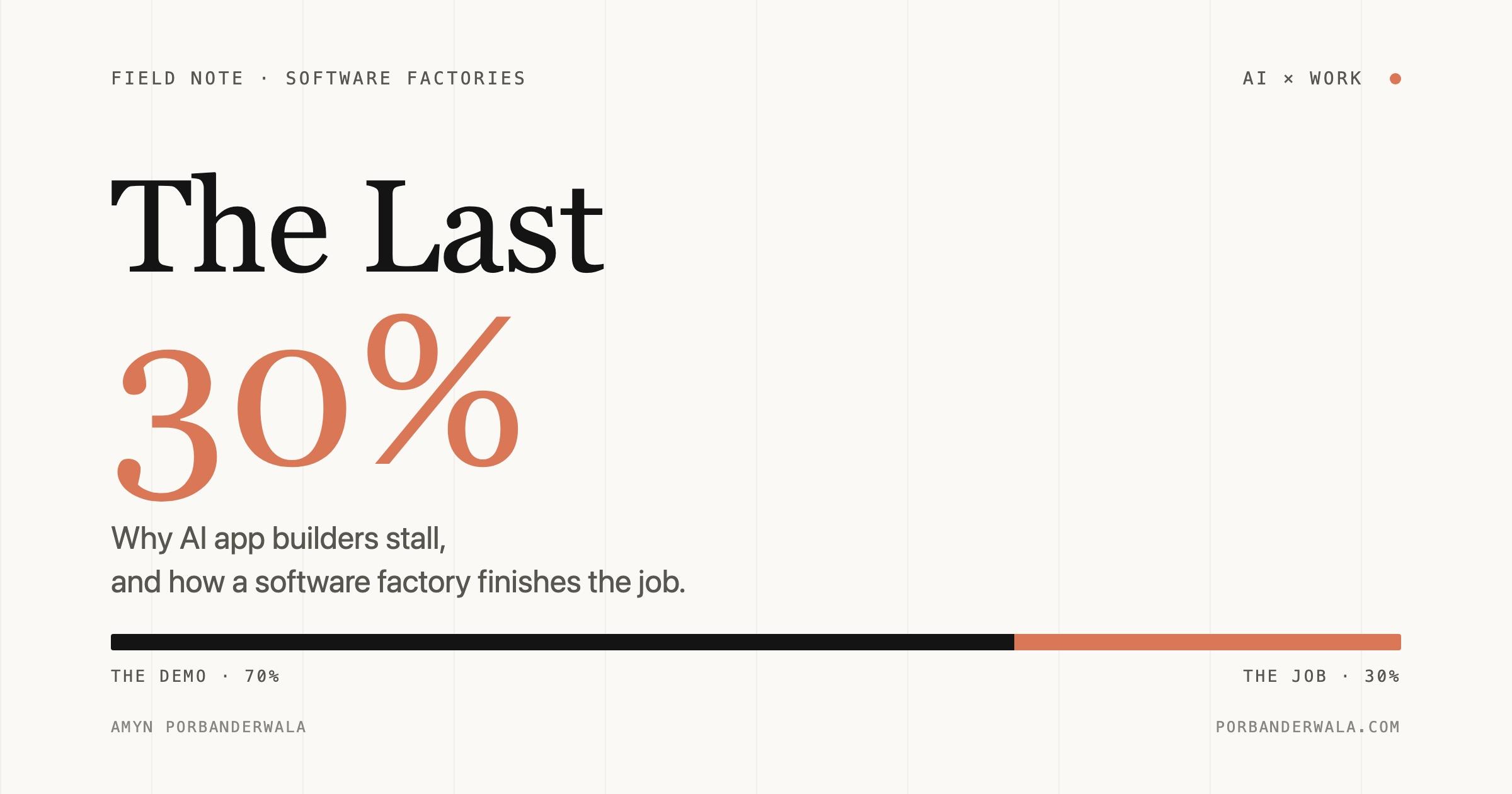
A Software Factory Finishes What an AI Builder Starts
An app builder gives you a working demo in an afternoon. The last stretch needs a spec, small tickets and gates, and that loop is the product.

Your Agent Needs a Chain of Custody, Not a Better Prompt
The model is the cheap part. What makes an agent deployable is the audit record: what it did, with what arguments, under whose authority.

The AI Stack You Can Defend: Six Tests Before You Say Yes
A six-question test for any AI tool you plan to use with a federal customer, and the answers that should disqualify it fast.
What a Headless Agent Costs After the Demo
A persistent agent is cheap to start and expensive to supervise. Three costs the launch posts omit, and the controls that make them payable.
2025: The Year AI Became Infrastructure, Not Magic
The demos stopped being the deliverable. Cost, evaluation, and integration became the work, and that is what made AI usable.

Synthetic Data Does Not Solve the Classified Problem
Generating the data is the easy half. Proving it did not inherit a classification and that a model learned from it is where programs stall.
What Allianz's Claims Agent Actually Automates
Allianz now runs an agentic AI on small damage claims. The lesson for federal claims shops is the escalation boundary, not the model.
Price per Token Is the Wrong Number for Model Selection
Anthropic cut Opus pricing by about two thirds. The cost that decides a deployment is still the completed task, not the token.
Agent 365 Is an Inventory Problem Wearing a Dashboard
Agent 365 gives every agent an identity and a policy. That only works if the registry is complete, and agent inventories decay fast.

Agentforce Works Because the CRM Was Already Governed
Salesforce's agents inherit an object model and a permission model that predate them. That is why they work, and why they stop at the CRM.
Agentic Commerce Solves Checkout, Not Spending Authority
The Agentic Commerce Protocol gets the token right: a permission that carries its own limit. Federal money needs something a limit cannot supply.

GPT-5-Codex Moves the Bottleneck to Review
The agent can write more code than a team can inspect. The constraint is no longer generation, it is the review record that makes code defensible.
The Model Spec Is a Promise, Not a Control
OpenAI's Model Spec sets out how its models should behave. It also says production models do not yet match it, which is the part worth reading twice.

GPT-5 Picks Its Own Effort. Your Budget Cannot.
GPT-5 routes between models and effort levels on its own. That is convenient in a chat window and a problem for cost, testing and reproducibility.
DeepSeek Halved Its Hallucination Rate. Yours Is Different.
DeepSeek says its update cut hallucinations by up to half. That number came from its benchmarks, not from your task, and the gap is the whole job.
AI Can Prove the Wrong Specification Perfectly
DeepSeek's prover is a real advance in Lean proofs. The bottleneck in critical systems is still the English sentence the proof must satisfy.
The Open Stack's Advantage Is Provenance
Cost is the least interesting reason to build on open components. The one that survives procurement is knowing where the weights and data live.
Strategic Convergence Starts at the Interface
AI does not transform an industry by being added. It transforms the place where a decision already has a system of record and an owner.

AI in Regulated Work Is an Evidence Problem
Healthcare and defense have the same blocker. It is not model quality. It is whether you can show a control was satisfied when the system acted.
What an AI Solutions Manager Actually Owns
The job is not model selection. It is the decision boundary, the failure budget, and the evidence that survives after the demo team goes home.
A Use Case Is a Decision, Not a Demo
Most AI use cases fail before the model is built. They fail because no one named the decision, the owner, or the cost of being wrong.
"Clean Your Data First" Is Unbounded Advice
Data is never clean. It is either fit for a specific decision or it is not, and the difference is a threshold somebody wrote down before the build.

Pick the Simplest Model That Clears Your Threshold
Model selection is not a menu of algorithms. Set the threshold first, then take the simplest model that meets it, because that is the one you can defend.
Pick the ML Type You Can Acceptance-Test
Supervised, unsupervised or reinforcement: the real difference is what you can prove at acceptance, and who holds the test data.
End of page 1 of 2. The archive continues.